AMD Releases FSR SDK 2.2 with Enhanced Upscaling and Ray Regeneration
AMD has officially launched the FidelityFX Super Resolution (FSR) Software Development Kit (SDK) version 2.2, introducing significant advancements in upscaling and ray tracing technologies for game developers and graphics enthusiasts. This latest release, showcased alongside the Adrenalin Edition 26.3.1 WHQL driver, brings new features designed to elevate visual fidelity and performance on compatible AMD hardware.
FSR Upscaling 4.1: Sharper Details and Improved Motion Rendering
The updated FSR "Redstone" SDK v2.2 debuts FSR Upscaling 4.1, a major improvement for the RDNA 4 family of graphics cards. Compared to its predecessor, FSR 4.0, the new version delivers noticeably finer details, particularly in dynamic scenes. For example, in the Crimson Desert game demo, grass swaying in the wind appears significantly more detailed and natural with FSR 4.1, eliminating the blur that was present in earlier versions. This enhancement brings visuals much closer to native rendering quality, offering gamers a more immersive experience without sacrificing performance.
Ray Regeneration 1.1: Real-Time Ray Tracing Enhancements
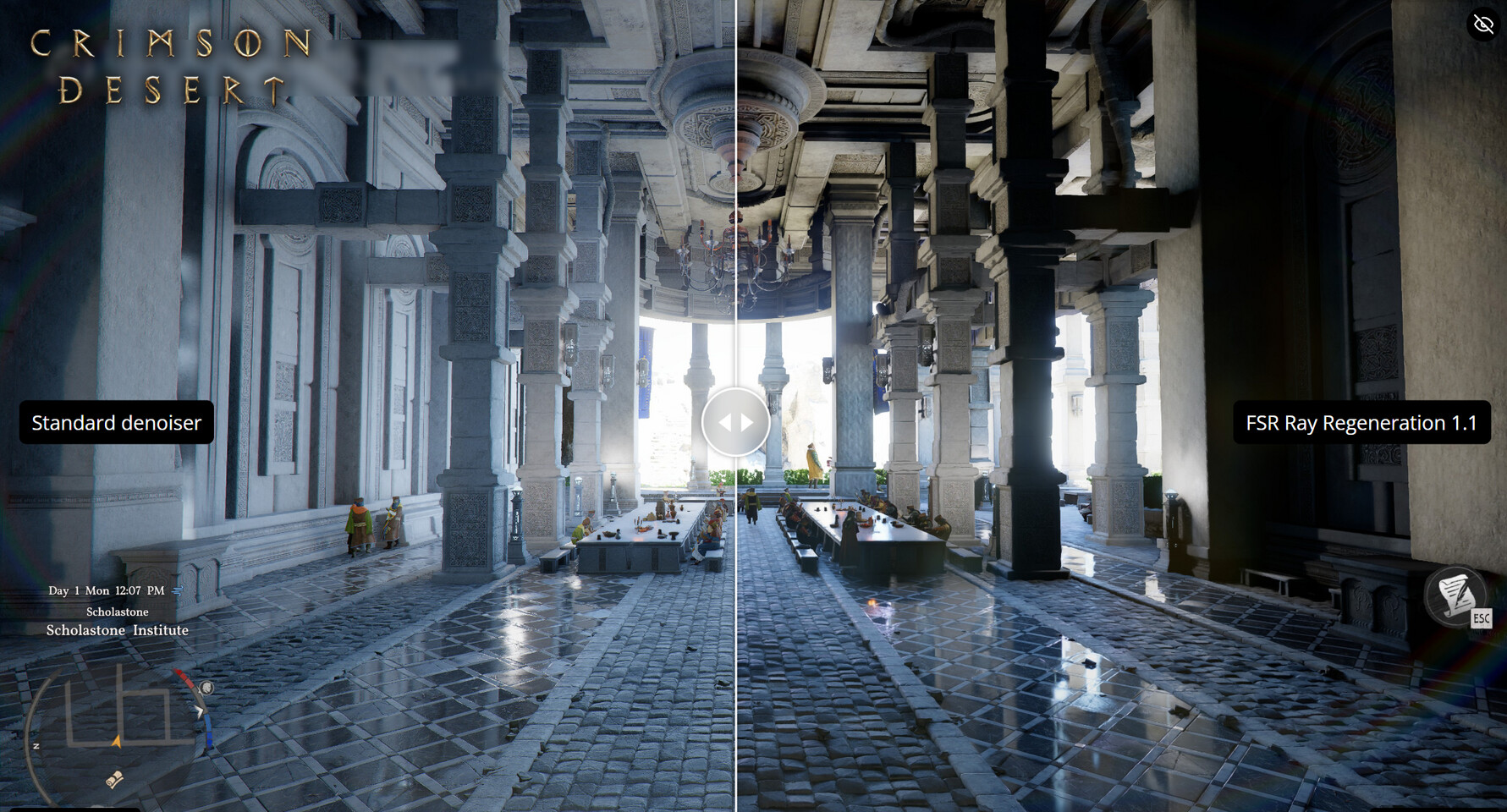
Another highlight of the FSR SDK 2.2 is the inclusion of Ray Regeneration 1.1. This technology addresses the inherent noise produced by real-time ray tracing, processing and refining the output to deliver sharper, more polished visuals. The latest update enhances shadow depth, lighting realism, and overall image quality, all without requiring developers to make extensive changes to their existing rendering pipelines. Ray Regeneration 1.1 leverages DirectX 12 Shader Model 6.6, ensuring compatibility with the latest graphics standards.
Additional Features and Compatibility
The FSR SDK 2.2 also introduces AMD FSR Frame Generation 4.0.0 in its standard version, as well as a technical preview of AMD FSR Radiance Caching 0.9.0. Notably, FSR 4.0, FSR 4.1, and Radiance Caching 0.9 require a Radeon RX 9000 series GPU equipped with RDNA 4 architecture. For Ray Regeneration 1.1 and Radiance Caching, DirectX 12 Shader Model 6.6 is mandatory, which is available through the DirectX 12 Agility SDK 1.4.9 or newer.
It is important to note that Vulkan support is currently absent in SDK 2.2, as listed in AMD’s known issues. The reliance on DirectX 12-specific shader models for some "Redstone" technologies may limit future Vulkan compatibility, though AMD has not provided further details on potential support.
Conclusion
With the release of FSR SDK 2.2, AMD continues to push the boundaries of real-time graphics rendering. The improvements in upscaling and ray tracing technologies offer developers powerful tools to enhance visual quality and performance on the latest Radeon hardware. As the ecosystem evolves, these advancements are set to play a key role in the next generation of gaming experiences.